
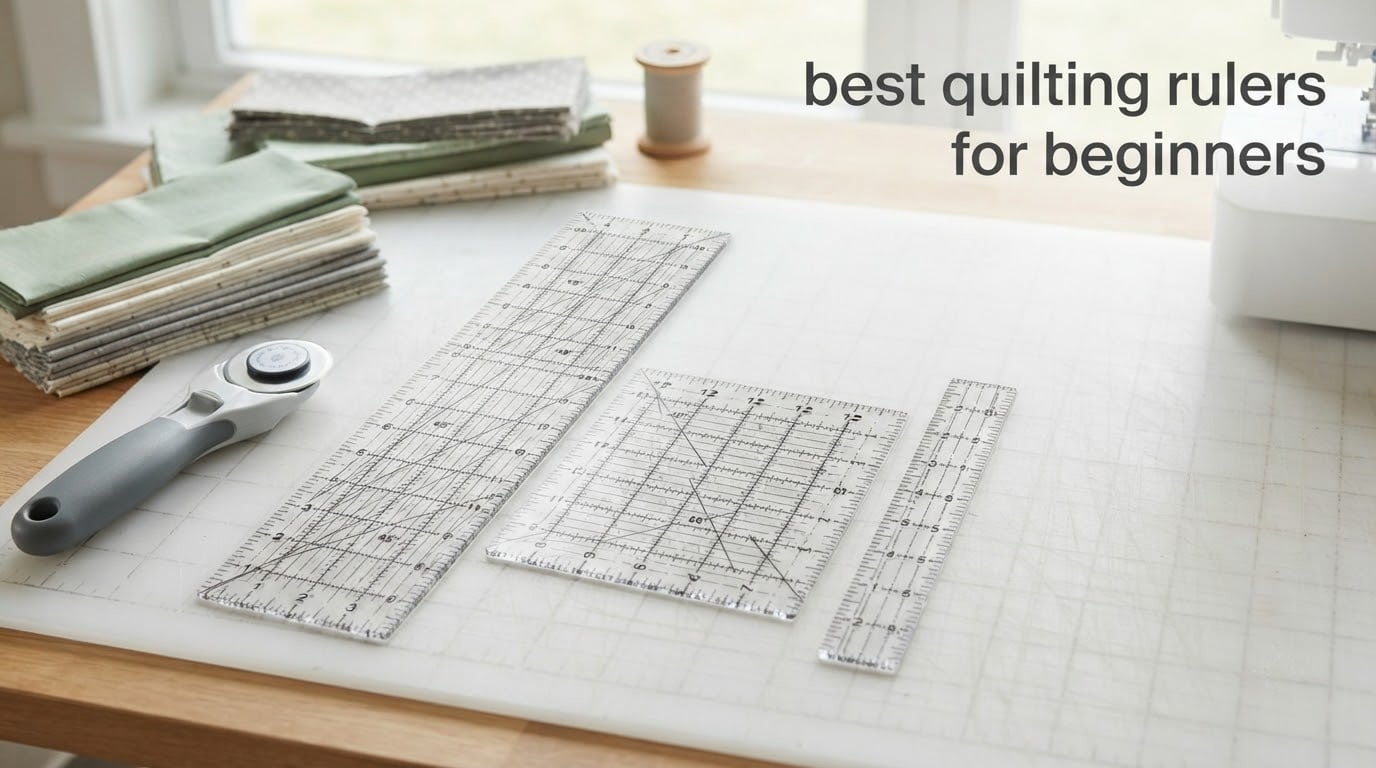
A beginner needs three quilting rulers and nothing more: a 6.5 by 24.5 inch long strip ruler, a 6.5 inch square ruler, and a medium rectangle around 6.5 by 12.5 inches. Those three cover every cut a new quilter makes, from strips out of yardage to squaring up a finished block. Everything else on the shelf is an upgrade you can buy once you know which jobs you actually repeat.
The problem is that a quilting shop or an Amazon category page shows you squares, rectangles, triangles, hexagons, slot rulers and specialty square-up templates with no explanation of what any of them are for. Our team compared eight rulers across shapes and sizes, checked the marking systems, grip behavior and thickness on each one, and sorted out which ones earn a place in a beginner’s kit in 2026.
Accuracy is the whole reason a quilting ruler exists. A block that is off by a fraction of an inch will not square up later, and that error compounds across a quilt until the whole thing ripples instead of lying flat. A ruler is what lets you make the same cut twice, on a Tuesday and again on a Sunday, and get the same result. If you are still choosing between machines before you start cutting, our beginner quilting machine guide covers the other half of the starter setup.
Table of Contents
Top 3 Quilting Rulers for Beginners in 2026
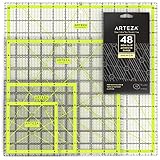
ARTEZA 4-Piece Square Ruler Set
- Four square sizes 4.5 6 9.5 and 12.5 inch
- Dual-color black and lime grid lines
- 48 non-slip rings
- 30 45 and 60 degree angle guides

Omnigrip 6 x 12 Inch Rectangle
- Patented non-slip backing
- Highlighted 1/8 inch edge markings
- 1/4 inch dot and line grid
- 30 45 and 60 degree lines

Omnigrip Quilter’s Square 15 Inch
- 15 by 15 inch square body
- Durable premium acrylic
- Readable on dark and light fabrics
- Non-slip grip surface
8 Best Quilting Rulers for Beginners (October 2026)
| Product | Specifications | Action |
|---|---|---|
| ARTEZA Acrylic Quilting Rulers Set of 4 |
|
Check Latest Price |
| Omnigrip 6 x 12 Inch Non-Slip Rectangle |
|
Check Latest Price |
 Omnigrip 1 x 6 Inch Clear Ruler Omnigrip 1 x 6 Inch Clear Ruler |
|
Check Latest Price |
 Fiskars 3 x 18 Inch Acrylic Ruler Fiskars 3 x 18 Inch Acrylic Ruler |
|
Check Latest Price |
| Omnigrip Quilters Square 15 x 15 Inch |
|
Check Latest Price |
 LINXIAO 4 Piece Acrylic Square Set LINXIAO 4 Piece Acrylic Square Set |
|
Check Latest Price |
 VPVPV 5 Piece Quilting Ruler Set VPVPV 5 Piece Quilting Ruler Set |
|
Check Latest Price |
 AUTOTOOLHOME Acrylic Ruler 6.5 x 12 Inch AUTOTOOLHOME Acrylic Ruler 6.5 x 12 Inch |
|
Check Latest Price |
1. ARTEZA 4-Piece Square Ruler Set – The Best All-Round Starter Set
ARTEZA Acrylic Quilting Rulers, Set of 4 for Sewing and Fabric Cutting
Four squares: 4.5 6 9.5 and 12.5 inch
0.1 inch acrylic
48 non-slip rings
Pros
- Four square sizes in one purchase
- Grid readable on light and dark fabric
- 48 non-slip rings included
- 30 45 and 60 degree angle guides
- 0.1 inch laser-cut acrylic
Cons
- Non-slip rings must be applied before use
- Square-only set so a long strip ruler is still needed
The first thing I noticed with this set is how much you get for a single decision. Four square rulers, at 4.5, 6, 9.5 and 12.5 inches, arrive together and between them cover almost every block size a beginner will sew in the first year. That removes the single biggest source of shopping paralysis, which is trying to work out which square you need before you know what block sizes you keep making.
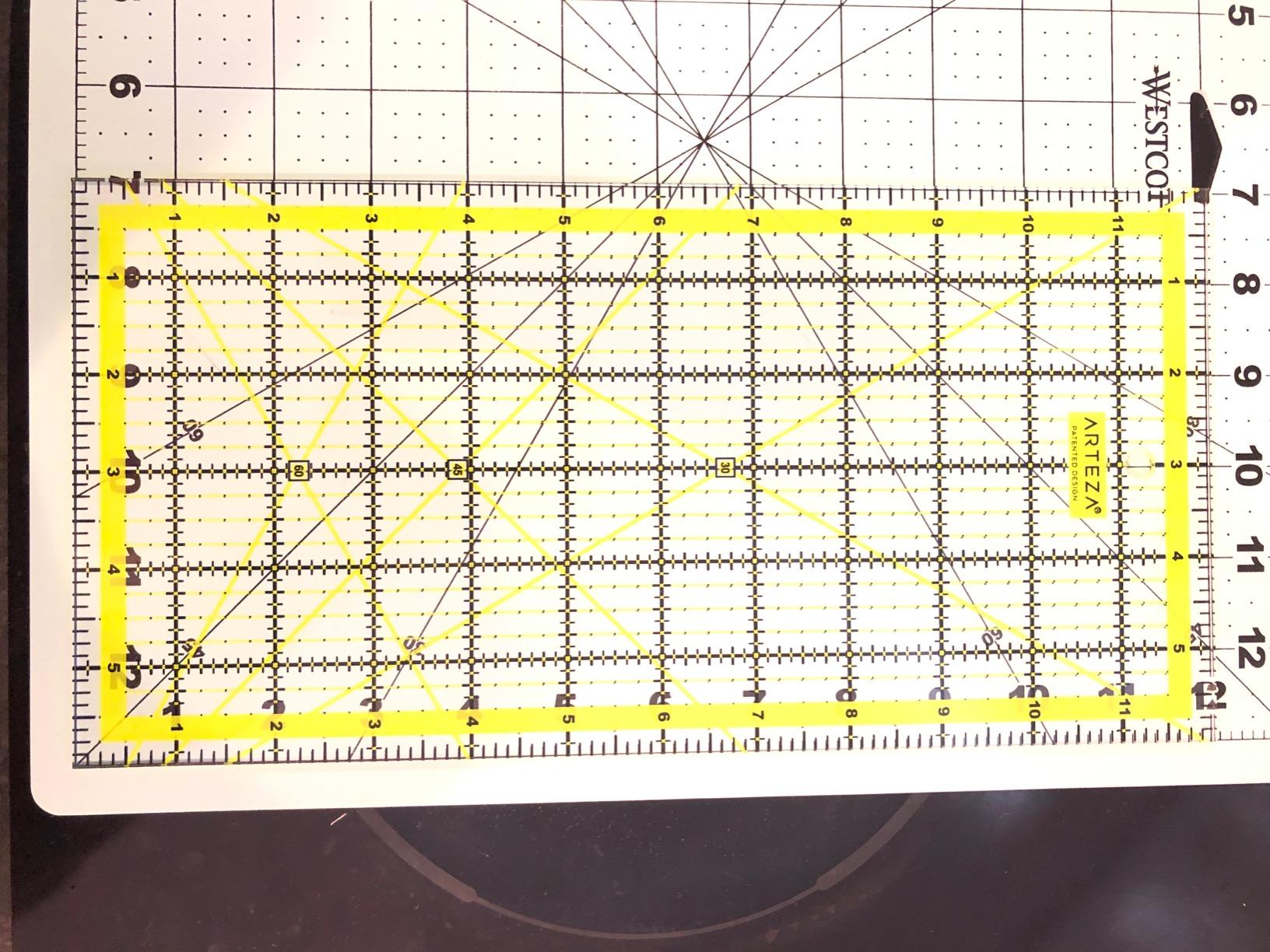
The marking system is the other reason it works so well. You get a dual-color grid in black and lime green, and that pairing is the difference between a line you can follow and a line you squint at. On a dark navy print or a busy floral, the black line carries; on white or pale fabric, the lime line carries. We cut on both light and dark cottons with these and never had to stop and re-find the seam allowance line.
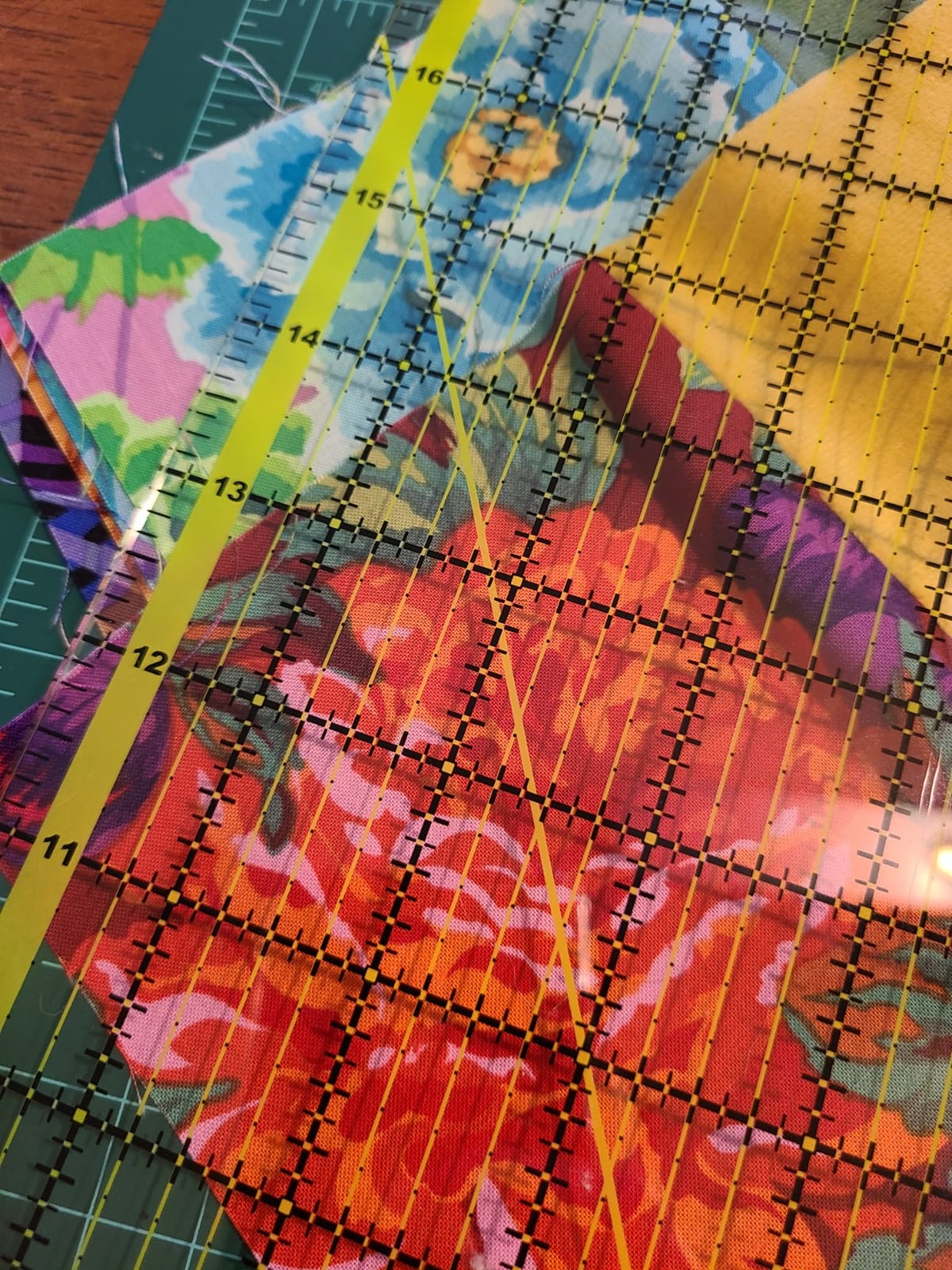
At 0.1 inches thick, the acrylic is on the slim side but laser-cut smooth, which is the part that actually matters to a rotary cutter. The blade rides along the edge without catching, and the ruler does not fight you on the pass. Compare that to a cheap edge that has not been properly finished, where the blade snags and drags fabric with it.
There are 48 adhesive non-slip rings in the box. Apply them to the back of the four squares and the grip goes from fine to genuinely solid, which is the difference between a cut that stays where you put it and a cut that creeps halfway through. It takes a couple of minutes the first time and then you never think about it again.
Why it works for a beginner cutting their first blocks
A 4.5 inch square is small enough to trim a block down without over-cutting, and a 12.5 inch square is big enough to handle a full block plus seam allowance in one pass. Having both means you learn to read the lines rather than to guess which tool to grab, and reading the lines is the actual skill being learned here.
The 30, 45 and 60 degree angle guides are also quietly useful. The 45 degree line is what you want for trimming half-square triangles, and having it etched into the ruler means you are not eyeballing a diagonal. A straight diagonal trimmed with a guide squares up properly later, which is where a lot of beginner quilts go wrong.
Where it falls short
This is a square-only set, and that is a real limitation. There is nothing in the box for cutting long strips out of yardage, so you will still need a rectangle for sashing, borders and binding. If you only buy one thing from this page, this is not the one to buy, because the long ruler does more work in a first project than the square does.
The non-slip rings are also a do-it-yourself step that is easy to skip and impossible to un-notice afterwards. Out of the box the acrylic is smooth and it will move on a slick mat. Put the rings on before your first real cut and the whole experience changes.
2. Omnigrip 6 x 12 Inch Rectangle – Best for Strips and Sashing
Omnigrip Non-Slip Rectangle Quilting Ruler, Cuts 6″ x 12″ Fabric
6 by 12 inch rectangle
Patented non-slip backing
1/8 inch markings
Optical-grade acrylic
Pros
- Patented non-slip backing holds during cuts
- Highlighted 1/8 inch edge markings
- 1/4 inch dot and line grid
- Numbering works from either end
- 30 45 and 60 degree lines
Cons
- Can still shift depending on how it is gripped
- Occasional reports of chipped corners on arrival
This is the shape that does the most quiet work in a beginner’s studio. A 6 by 12 inch rectangle is not glamorous, but it sits perfectly inside a half-size cutting mat, which means every cut you make with it is a single clean pass instead of a pass that runs off the edge of the mat partway along.
The patented non-slip backing is the feature worth paying for. It is not a coating you have to apply and not a ring you have to stick on, it is built into the ruler, so grip is there from the first cut. On a long border cut, a ruler that creeps by a few millimeters ruins the width of every strip you cut from it, and this one does not creep while the blade is moving.
Marking density is the other strength. You get highlighted 1/8 inch markings running along the edge and a 1/4 inch dot-and-line grid across the body, so you can read a measurement at a glance without counting grid lines. For binding strips at 2.5 inches, which is the standard, that density saves you a lot of measuring and re-measuring.
Why it works for strips, sashing and borders
Strip cutting is repetitive, and repetitive work is where consistency matters most. Two strips cut an eighth inch apart look identical until they go into a border and the border comes out wavy. The dot-and-line grid on this ruler is dense enough that you set the ruler against the edge once and read the number directly, and that number is the same number every time.
It also handles smaller jobs well. Making a set of 2 inch strips for a mini quilt, or cutting binding from a fat quarter, this size is comfortable to control in a way that a 24 inch ruler is not. Smaller pieces are easier to reposition, and repositions are where accuracy leaks away.
Where it falls short
Some reviewers report the ruler can still shift depending on how it is gripped, and we found the same thing on a first cut when the hand was light. Press across the body of the ruler with your whole palm rather than holding an edge, and the shifting stops being an issue.
There are also occasional reports of items arriving with chipped or damaged corners, which matters because a chipped edge is exactly where your blade runs. Inspect the corner the moment it arrives rather than after you have cut half a quilt top.
3. Omnigrip 1 x 6 Inch Strip Ruler – Best for Narrow Strips and Binding
Omnigrip 1″ x 6″ Clear Quilting Ruler by Omnigrid
1 by 6 inch narrow strip
Laser-cut smooth edge
Black and yellow print
13.61 g
Pros
- Ideal body for tight strips and small details
- Laser-cut edge lets the blade cut deeper
- Black and yellow print reads on dark and light fabric
- Works for either hand
- Light enough to live in a sewing kit
Cons
- One inch width limits it to narrow cuts
- Listing describes the material as fabric rather than acrylic
Everything on a large rectangle is built around the biggest cut you can make. This is the opposite: a 1 by 6 inch strip ruler exists so you can make small, exact cuts in places a bigger ruler will not physically fit. Cutting binding strips from a fat quarter, trimming a narrow edge allowance, or making a small patch unit with a few millimeters to spare, all of these want a tool this narrow.
The laser-cut smooth edge is doing more work here than the size is. A narrow ruler is essentially a long blade guide, and any roughness along that edge translates directly into a wandering cut. This one is finished smooth enough that the rotary cutter tracks it cleanly through a double layer of fabric.
At 13.61 grams it is the lightest ruler in our whole comparison, which sounds like trivia until you are trying to keep your cutting kit in one bag. It is the ruler that comes to a class or a weekend retreat with you instead of staying home in a drawer.
Why it works when space is tight
The 1 inch body is narrow enough to work right up against a seam line or an edge of fabric where a 6 inch rectangle simply overhangs into nothing. On a small project like a scrappy tote panel or a set of 2 inch squares, this is the tool that lets you finish a cut you would otherwise leave unfinished and come back to later.
The black and yellow print keeps the grid visible on both dark and light fabric, which sounds like a small detail until you are trying to find a 1/8 inch line on a black print in evening light. It is legible, and legibility is what keeps a small ruler from becoming a guessing tool.
Where it falls short
The one inch width is a hard limit. If you try to use this for a medium cut you will end up running the blade past the end of the ruler, which is how blades get dulled and fingers get hurt. Treat it as a finishing tool for narrow work, not as a substitute for a rectangle or square.
One more practical note: the listing describes the material as fabric rather than acrylic, which is almost certainly a cataloguing error rather than a different product. If that detail matters to you, confirm the material before you commit.
4. Fiskars 3 x 18 Inch Ruler – Best for First-Time Quilters
Fiskars 3″ x 18″ Acrylic Sewing & Quilting Ruler with Gridlines, Clear
3 by 18 inch clear acrylic
Highlighted seam allowances
Removable non-slip feet
Lifetime warranty
Pros
- Bold grid makes strip measurements quick
- Highlighted seam allowances show clearly
- Broken grid lines reveal the fabric edge
- Non-slip vinyl feet can be added or removed
- Backed by a full lifetime warranty
Cons
- Finer grid lines take getting used to
- Some reviews cover a related 24 by 6 inch variant
Fiskars is a name most beginners already recognize from their general sewing supplies, and that familiarity has real value. There is nothing confusing about picking this up. It is a 3 by 18 inch clear acrylic ruler with a bold measuring grid, highlighted seam allowances and broken grid lines that let you see the fabric edge beneath the ruler while you position it.
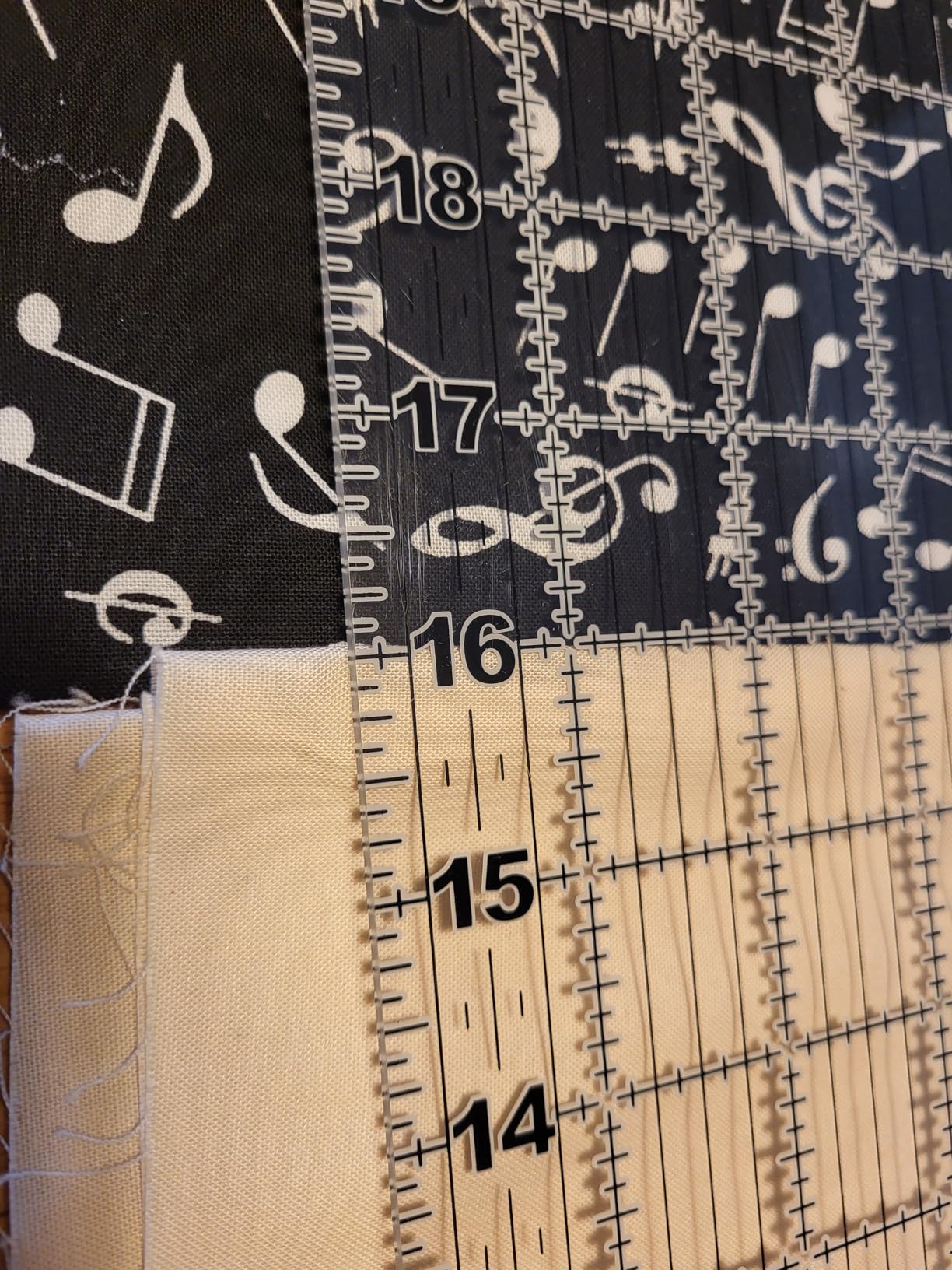
Those broken grid lines are a genuinely thoughtful detail. On a solid-colored ruler, the grid hides the fabric edge and you end up nudging and nudging until a faint line lines up. Here the grid breaks so the edge is always visible, which is the difference between a confident cut and a hesitant one for someone who has not done this many times.
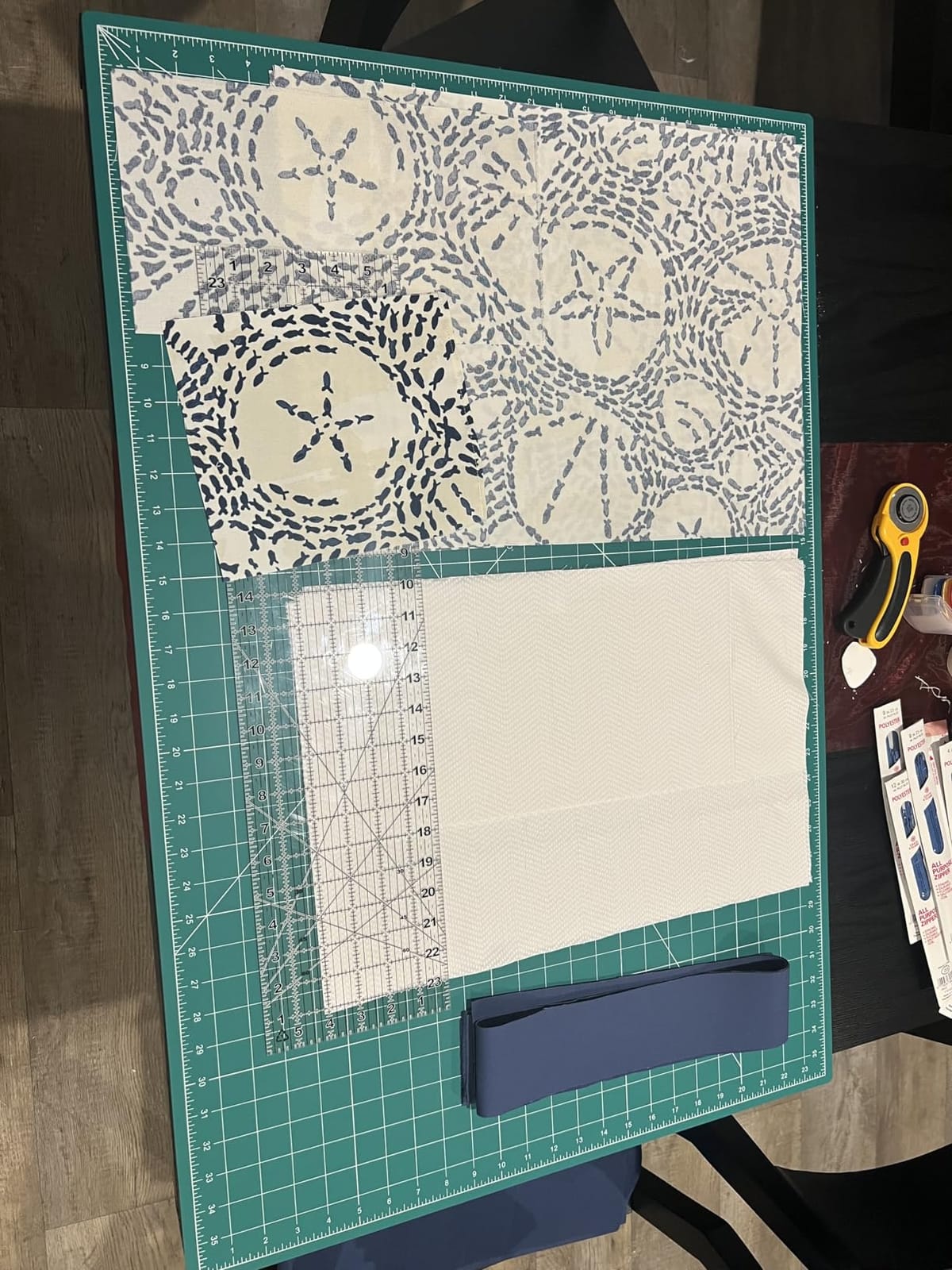
The non-slip feet are removable, and that is more useful than it first sounds. Leave them off when you want to slide the ruler into position, put them on when you are making the cut and need it to stay. A permanent grip is not always the right answer, and this ruler lets you choose without buying a second tool.
It is also compact enough to fit in a sewing machine case. For a beginner who is not yet set up with a dedicated cutting table, a ruler that travels with the machine is a ruler that gets used, and a ruler that gets used is worth far more than one that stays in a drawer.
Why it works for a first project
Three inches wide is narrow but not fiddly, and 18 inches long is a standard length that pairs with almost any cutting mat. The bold grid is legible from arm’s length, which matters when you are leaning over a table rather than sitting at a desk. Most first projects are strip quilts, and this ruler is built for exactly that.
The lifetime warranty is the quiet confidence in the build. Acrylic this clear and this flat is not cheap to make, and the fact that a manufacturer will stand behind it indefinitely tells you something about how the material is cast.
Where it falls short
Some users find the finer grid lines harder to read at a glance, particularly the eighth inch increments. The bold outer measurements are clear; the interior detail takes an afternoon to become automatic. If you need precision at one eighth inch constantly, a denser grid is a better fit.
Also worth knowing: some of the reviews on this listing cover a related 24 by 6 inch rotary cutter variant, which has its own separate characteristics. Judge this ruler on the 3 by 18 inch product, not on the mixed feedback.
5. Omnigrip Quilter’s Square 15 x 15 Inch – Best for Large Blocks
Omnigrip Quilter’s Square Ruler by Omnigrid – Cuts 15″ x 15″ Fabric
15 by 15 inch square
Premium acrylic
Easy to read markings
Non-slip grip surface
Pros
- Highest average rating in the group
- Large enough for full blocks and long strips
- Markings readable on dark and light fabrics
- Stable non-slip grip for squaring
Cons
- Bulkiest square ruler in this comparison
- Oversized for most beginner block sizes
This is the only 4.9 rated ruler in our comparison, and the reason shows up in the ratings distribution rather than the specification sheet. Owners are not describing a feature, they are describing a ruler that did exactly what it was supposed to do every time they picked it up. Marking clarity and grip stability are what get mentioned, repeatedly.
At 15 by 15 inches it is a serious piece of equipment. A block that needs trimming to twelve inches fits with room to spare, and a full border or backing panel can be squared up in one pass. If you are quilting large blocks or working on a bed-size quilt, this single square does the job three smaller ones would.
The non-slip grip pattern is what makes squaring up reliable. Squaring up a block means holding the ruler absolutely still while you trim a corner, and any movement at that moment shows up in the finished block. A grip surface that holds under a rotary cutter with a firm palm is worth more here than any extra line on the grid.
Why it works for squaring up large blocks
When a block is bigger than your mat width, you cannot square it in one cut, and that is where large blocks usually go wrong. A 15 inch square on a standard mat lets you work across the full body and then reposition, which keeps the measurement consistent between passes. Repositioning is where errors enter.
The easy-to-read markings work on both dark and light fabrics, which matters more on big blocks because you are often trimming multiple layers of fabric with a busy print showing through. The lines stay findable even when the fabric underneath is not cooperating.
Where it falls short
It is the bulkiest square ruler in this comparison, and at 1.2 pounds it is a solid object to pick up one-handed while repositioning. For most beginners working on 8 inch blocks, this is more ruler than the job requires, and a 6.5 inch square would be easier to control.
That is the honest read: excellent ruler, later purchase. Buy a small square first, learn what block sizes you actually sew, and add this one when the small square stops being enough.
6. LINXIAO 4-Piece Square Set – Best Value Square Set
Quilting Rulers,Sewing Ruler,4 Piece Acrylic Square Quilting Templates,Clear Precision Ruler for Quilting Sewing,Tools Supplies Accessories Green(3.5″x3.5″ 5″x5″ 6.5″x6.5″ 10.5″x10.5″)
Four sizes: 3.5 5 6.5 and 10.5 inch
Green fade-resistant markings
90 and 45 degree guides
Pros
- Four square sizes in one purchase
- High-contrast green markings on light and dark fabric
- Acrylic described as crack and warp resistant
- 90 and 45 degree guides included
- Flat design resists sliding under a cutter
Cons
- Lightweight build feels thinner than premium sets
- No non-slip rings included in the box
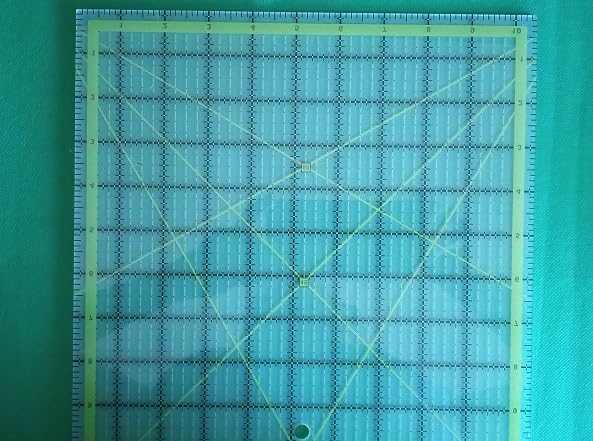
This set does something the ARTEZA set does not: it includes a 6.5 inch square, which is the single most useful square size for a beginner working through standard block patterns. Combined with a 3.5 inch, a 5 inch and a 10.5 inch, you have the sizes that appear in the widest range of beginner quilt patterns.
The green markings are the visual signature here. They are described as fade resistant and they are high contrast against both light and dark fabric, which is the same requirement every good ruler has to meet. The 1/8 inch incremental scales plus 90 degree and 45 degree guides cover both squaring and diagonal work in one pass.
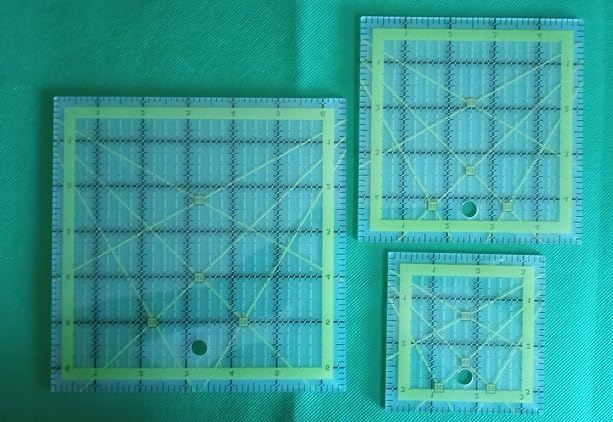
Buyers consistently highlight the range of sizes included, and that is the fairest summary. A four-square set in this class is not going to match a premium brand on optical clarity or edge finish, but for a beginner making standard blocks it covers the sizes that matter without a second purchase.
The flat, balanced design is what keeps it from sliding more than you might expect from a ruler with no added grip hardware. Weight alone does a lot of the work here: a flat ruler that weighs enough to resist a rotary cutter is already most of the way to stable.
Why it works for standard beginner blocks
Most beginner block patterns land at 4.5, 6, 6.5 or 9.5 inches finished. This set gives you 3.5, 5, 6.5 and 10.5, which is close enough to the working range that most of your blocks can be trimmed without a second ruler. A 10.5 inch square handles a 9.5 inch block with seam allowance built in.
That makes it a good companion to a long rectangle. The long ruler handles the yardage work, and this set handles everything that comes after the pieces are sewn together, which is the stage where beginners most often need a quick adjustment.
Where it falls short
The lightweight construction feels less substantial than the heavier premium sets, and a minority of buyers find the acrylic thinner than they expected. Thinness is not a dealbreaker for straight cuts, but if you like a ruler with real heft in the hand, this is not it.
There are also no dedicated non-slip rings in the box. You will want to add your own grip solution, or press hard and square with a firm palm, because a smooth back on a smooth mat will move.
7. VPVPV 5-Piece Ruler Set – Best All-in-One Travel Set
Sewing Ruler,5 Piece Quilting Rulers,3 x17 Inch,1.5 x17 Inch,3 x12 Inch,1.5 x10 Inch,1 x6 Inch,Acrylic Ruler,Cutting Ruler with Non-Slip Rings (Black and White)
Five rulers from 1x6 to 3x17 inch
15 non-slip grip rings
3mm thick acrylic
Pros
- Five sizes covering long strips and narrow work
- 15 grip rings fit any of the rulers
- 3mm laser-cut acrylic with smooth edges
- Measurements printed to the edge
- Compact enough for a sewing bag
Cons
- 17 inch length is non-standard
- Surface print can wear with heavy use
- Markings hard to read for low vision users
Sets that try to cover everything usually cover nothing well. This one comes close to fixing that. The five pieces are 3 by 17, 1.5 by 17, 3 by 12, 1.5 by 10 and 1 by 6 inches, which is a genuine range: long strips, medium rectangles, narrow strips and a small detail ruler, all in one purchase.
The measurements run to the very edge of each piece, which simplifies placement in a way that sounds minor and is not. You are aligning the fabric edge to a line and a number, and if the printed scale stops short of the edge you are estimating the last fraction. Printed to the edge, you are reading it.
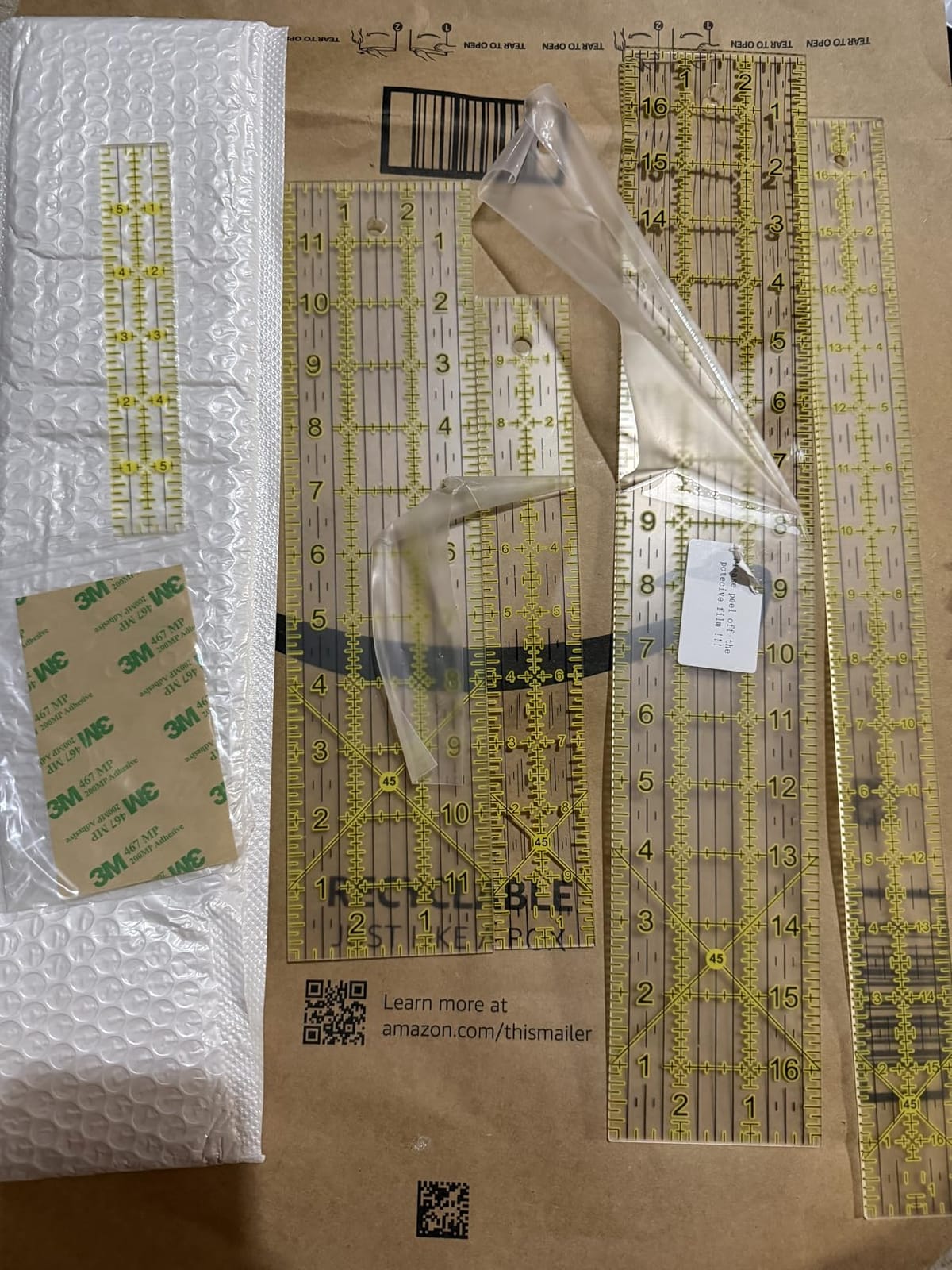
Fifteen non-slip grip rings are included and they fit any of the five rulers. That solves the grip problem for the whole set at once, which is a real advantage over a set that ships smooth and expects you to solve grip separately. Add the rings, place the ruler, cut, repeat.
At 3mm, the acrylic is thick enough to feel rigid and the laser-cut edges are smooth, so the blade tracks without snagging. The set is described as suitable for quilting, sewing, patchwork, piecing, measuring and drawing, which is honest, because these are general-purpose tools rather than pattern-specific templates.
Why it works if you quilt away from home
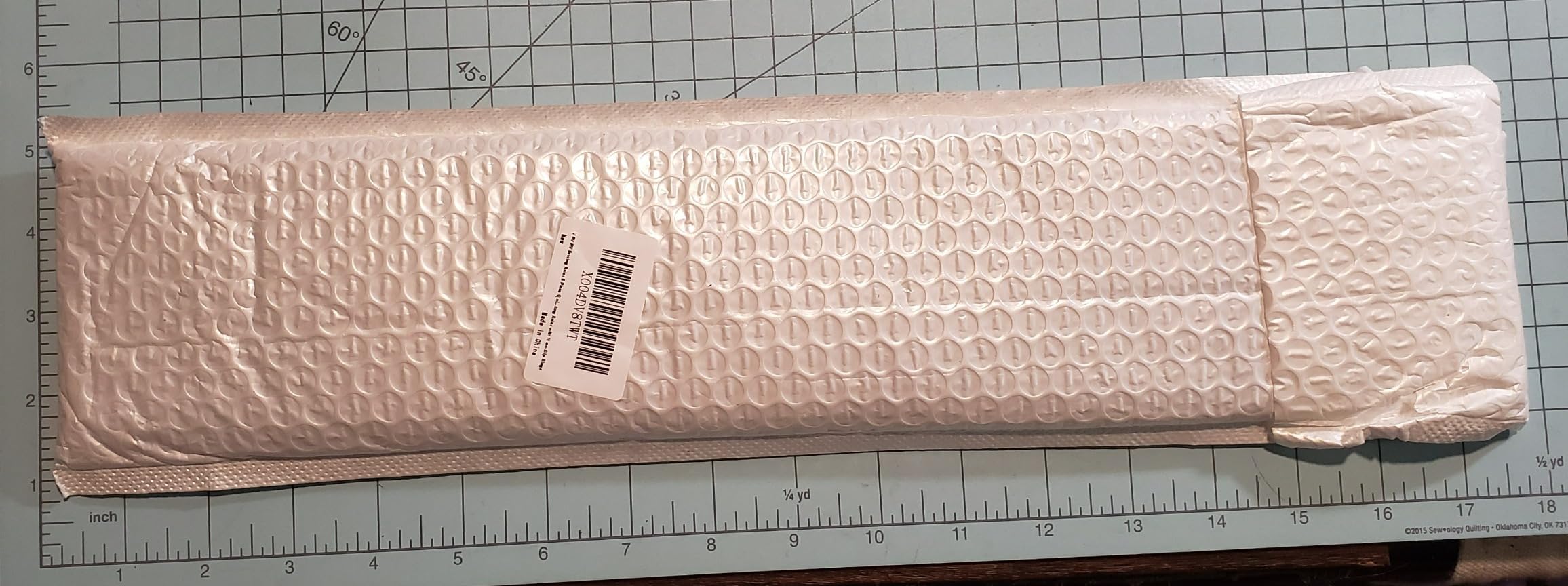
Five sizes in one pouch solves the portability problem better than any single ruler does. Classes, retreats and quilt nights all have the same issue: you need several rulers and you do not want to carry a drawer of them. Pick two or three of these and you have covered strips, blocks and detail work.
The 1.5 by 17 and 3 by 12 pieces are shapes that do not appear in most individual ruler ranges, and they fill real gaps. The 3 by 12 handles mid-size blocks neatly on a half mat, and the 1.5 by 17 is a narrow long ruler for trimming edges of borders without a 3 inch body overhanging.
Where it falls short
The 17 inch length is non-standard, and that has a practical consequence. If your cutting mat is sized around an 18 inch ruler, a 17 inch one leaves an inch of mat uncovered at the edge, and a cut that runs off the mat is a cut that damages the blade. Measure your mat before you commit to this set.
The print is applied to the surface rather than embedded, so markings can wear over long heavy use, and some buyers with low vision report that the markings are hard to read. If you need large, bold markings, a ruler with heavier print is a better fit.
8. AUTOTOOLHOME 6.5 x 12 Inch Ruler – Most Versatile for Mid-Size Blocks
Acrylic Quilting Ruler 6.5″ x 12″ Fabric Cutting Ruler for Sewing Crafts
6.5 by 12 inch clear acrylic
Clear grid and angle guides
Transparent body
Pros
- Matches common half-width cutting mat size
- Clear grid lines and angle guides
- Transparent body shows fabric underneath
- Works on fabric paper felt and vinyl
Cons
- Generic build with less quality history than name brands
- Rectangle only with no square or strip piece
A 6.5 by 12 inch rectangle is one of the most useful single dimensions in quilting, and this is the direct way to get one. It matches the half-width dimension of most self-healing cutting mats, so the ruler sits inside the cutting area with the blade running on mat the whole way along the edge.
Customers use it for patchwork blocks, strips and general craft cutting, and the clear grid lines, angle guides and numbered measurements cover the basics a beginner needs. The transparent acrylic body means you can see the fabric or a pattern underneath while you position it, which removes the guesswork from alignment.
The acrylic is laser-cut smooth, which is the part that actually decides cut quality. The blade rides the edge without catching, and the ruler does not fight you halfway along the pass. The versatility is real too: it works with rotary cutters on fabric, paper, felt and vinyl, so it is not dead weight if you also sew bags or do craft cutting.
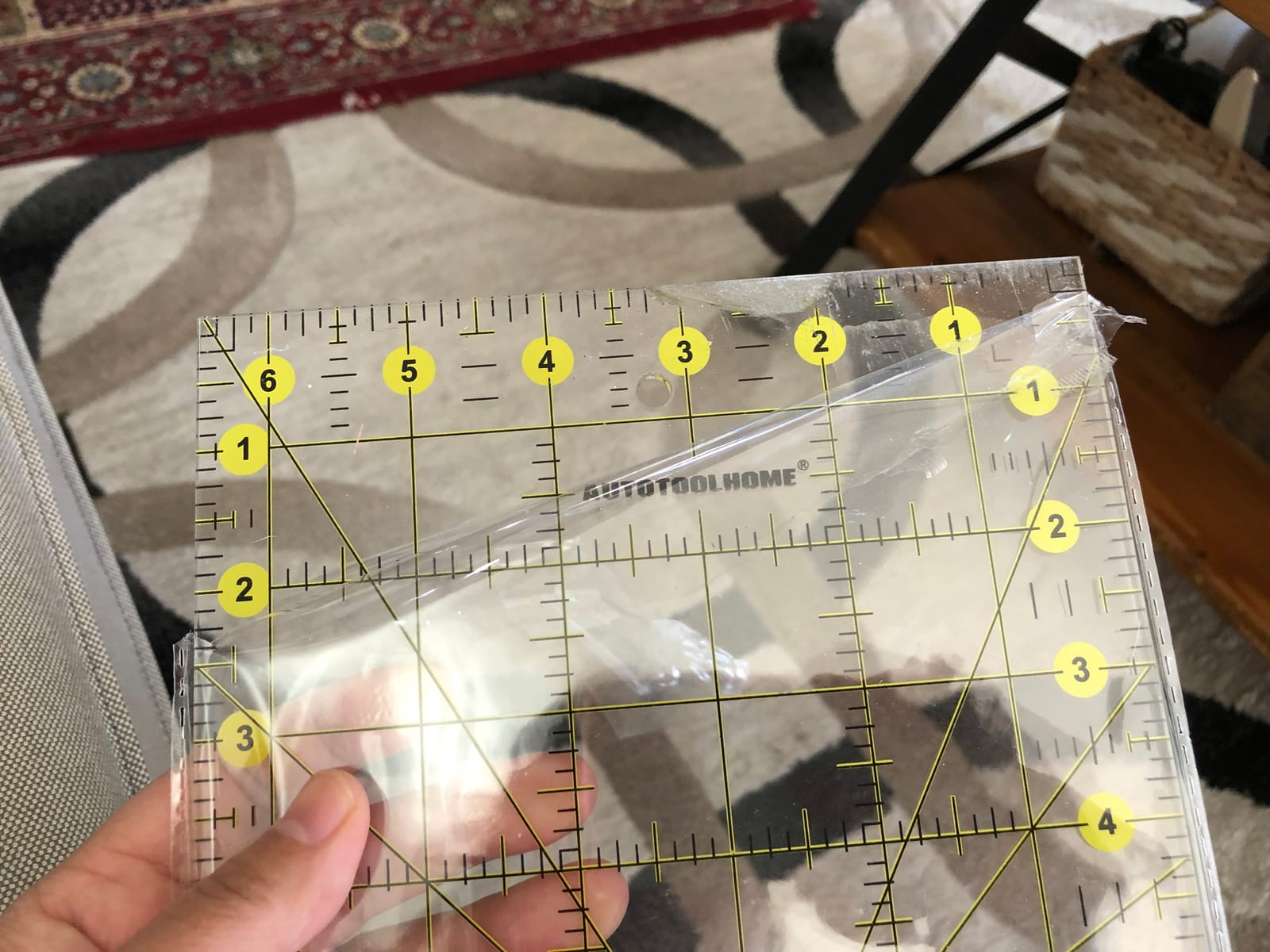
As the straightforward entry in this comparison, it does the plain rectangle job well without adding grip hardware or angle specialisation. If you have a cutting mat and a rotary cutter and you want one clear ruler that fits inside the mat, this is the most direct route to a working setup.
A 4.8 average across 935 reviews tells you what to expect: consistently good, occasionally unremarkable. Nobody is describing a revelation. They are describing a ruler that measured what it said and did not break, which for a beginner tool is most of the job.
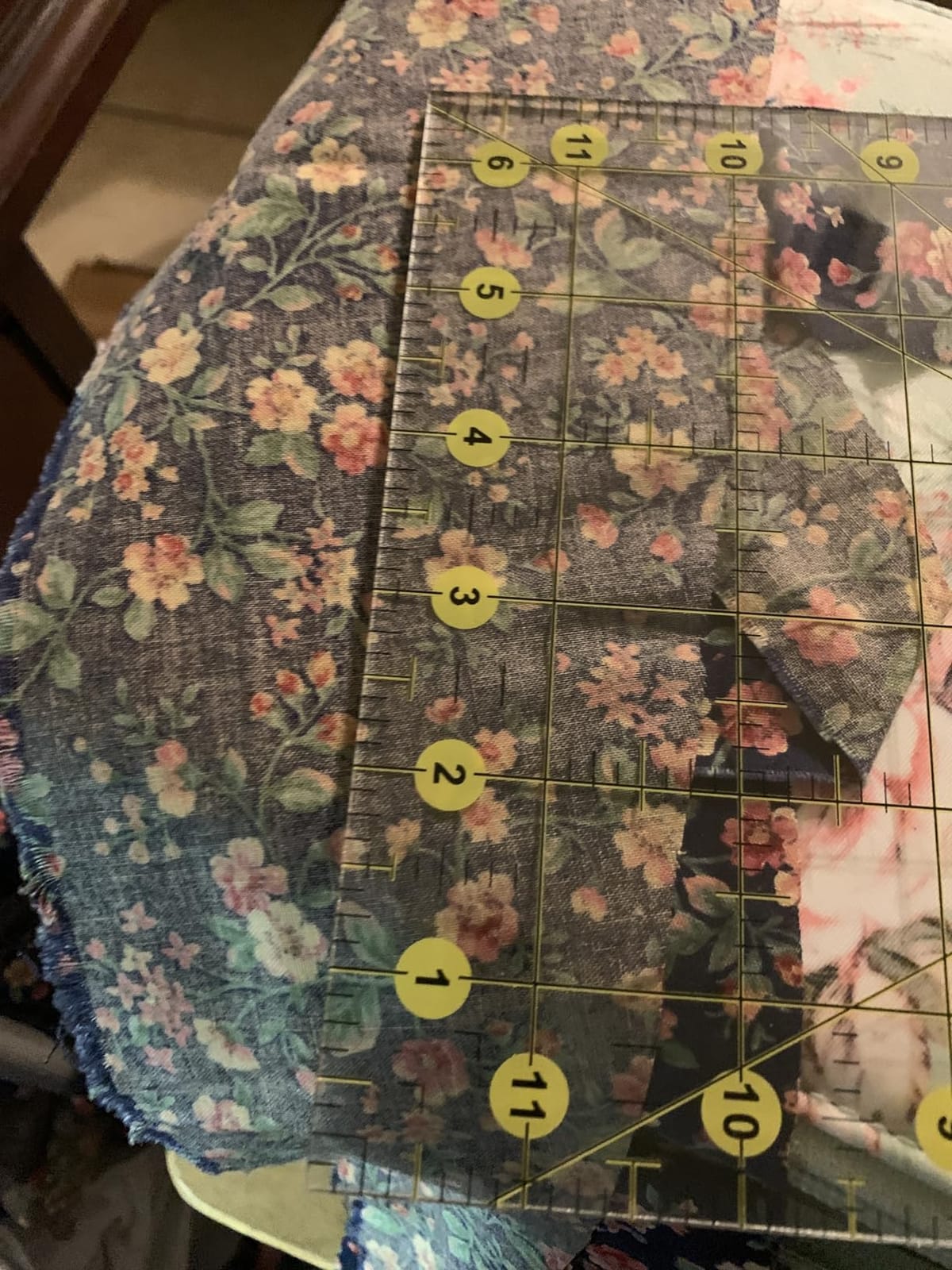
Why it works as a first rectangle
Matching the mat is the key advantage and it is not a small one. When the ruler overhangs the mat, the blade drops off the cutting surface partway along and the last portion of the cut is no longer clean. Sizing a rectangle to the mat means every cut is a full cutting-surface cut.
The angle guides and numbered measurements cover the two things beginners need beyond a plain scale: squaring a corner to 90 degrees and marking a diagonal. Neither requires a separate tool at this size, which keeps the setup simple while you are still learning what you need.
Where it falls short
The build is generic, and that means less established quality history than a name-brand ruler. It is not a problem in use, but if a corner chips or a print fades you have less recourse than you would with a manufacturer that carries a warranty.
It is also rectangle only, with no square or narrow strip piece in the box. Pair it with one square from either of the two four-piece sets above and you have covered the two shapes that matter most, without buying two separate rectangles.
Quilting Ruler Brands Compared
Brand matters in quilting rulers less for the shape and more for two specific things: how the grip behaves and how the markings read. Those two variables explain nearly every difference people notice between rulers that otherwise look identical.
Omnigrid and Omnigrip are the same company at two eras. The older Omnigrid line had a smooth back that many quilters found slipped, and the fix was to apply an anti-slip product to the bottom yourself. Omnigrip is the built-in version of that fix, with the grip pattern formed into the ruler. On QuiltingBoard, a user with older Omnigrid rulers described them as slipping and sliding all over the place and asked specifically what Omnigrip changes. The answer is the backing.
Creative Grids and Quilter’s Select are the two names most often recommended to beginners, and in that order in r/quilting, with the caveat that Creative Grids is often reported to cut about half an inch short on their ruler. Quilter’s Select is also noted for gripping very hard, so firmly that it cannot be nudged into position and has to be picked up and repositioned. That is a real trade: perfect stability in exchange for flow.
Olfa comes up as a current favourite for some quilters, with Quilter’s Rule named as the least favourite specifically because of the thickness of the printed lines. Line weight is more important than most spec sheets admit. A hairline grid that vanishes on a dark print is functionally the same as having no grid.
Bloc_Loc is the name behind specialty square-up rulers for half-square and quarter-square triangles, with seam allowances already frozen into the template lines. It solves one job perfectly and is not a general-purpose ruler, which is why it belongs on a beginner’s later list rather than the first one.
The one-brand rule is worth stating plainly because community advice is consistent on it. Quilters on Reddit repeatedly say to stick with a single brand so measurements stay consistent across sizes. A ruler from one brand and a square from another can measure nominally the same nominal size and still disagree, and that disagreement is invisible until a block will not square up.
How to Choose a Quilting Ruler
Grip decides whether a cut is accurate
A cut only fails when the ruler moves during it. Everything else about a ruler is secondary, and this is why grip is the first thing to check. There are four approaches you will meet, and all of them work.
Patented non-slip backings like the one on the Omnigrip rectangle are pressed into the acrylic, need no preparation, and are the simplest option. Adhesive non-slip rings, like the 48 that ship with the ARTEZA set, are applied to the back and are the most adjustable, because you can put them on only when you want maximum hold.
Removable vinyl feet, as on the Fiskars ruler, are a third option and the most flexible of all, since you can slide the ruler into position with them off and lock it down with them on. Frosted grip circles are the fourth, and they read well but tend to be the least aggressive of the four.
What you want to avoid is any ruler with a perfectly smooth back and nothing in the box to fix it. On a self-healing mat, a smooth-backed ruler creeps. You will not notice on a short cut; you will notice on your first long border.
How thick should a quilting ruler be?
Most quilting rulers land between 3mm, which is about 0.12 inch, and 0.13 inch, and within that range the difference is not what determines cut quality. Edge finish determines cut quality. A 3mm ruler with a laser-cut smooth edge will outperform a thicker ruler with a rough one every time, because the blade rides the edge rather than the thickness.
Thickness matters in one specific way, which is stacking. A thicker ruler stands more upright when you are holding it down, and that upright angle is what keeps the blade from drifting under the ruler. Very thin rulers can flex slightly if you press hard in the middle of a long span, and a flexing ruler is a drifting ruler.
So do not pay a premium for thickness. Check that the edge is smooth and that the acrylic is flat, and treat anything between a quarter inch and an eighth inch as completely fine for a beginner.
Omnigrid vs Omnigrip, explained
They are the same manufacturer, and the difference is entirely the backing. Omnigrid is the older line with a smooth bottom that many users report slipping. Omnigrip is the same ruler format with a grip pattern formed into the acrylic itself, so the ruler holds without you applying anything.
This is the direct answer to a question that has been open on quilting forums for years: nothing about the grid, the markings or the accuracy changed. Only the back did. If you are buying a new Omnigrid-branded ruler today, you are almost certainly buying the Omnigrip version, which is why the current listings carry the Omnigrip name.
For a beginner, this settles the question: buy the grip version, because the smooth version is the same ruler with a known problem left in place.
Match the ruler width to your cutting mat
Your ruler has to fit inside your cutting area, or you will run the blade off the mat partway along the cut and dull it. This is why the 6.5 by 12 inch rectangle is such a common recommendation: it matches the half-width dimension of most self-healing mats, so the blade stays on cutting surface for the full length of the cut.
On the Olfa versus Fiskars mat question, both are well-made self-healing mats and the difference matters less than the size. A larger mat accommodates the 6 by 24 inch style ruler, and a half-size mat pairs with a 6 by 12 or a 3 by 18. Buy the mat first if you have not already, then size the ruler to it.
Measuring your mat is thirty seconds of work that prevents a genuinely frustrating afternoon. Do it before you order anything.
Why sticking to one brand protects your accuracy
Because nominally identical rulers from different brands do not always agree, and you will not find out which ones disagree until a block will not square up. Line weight, etching depth and where exactly a manufacturer places the seam allowance line all vary, and a small difference compounds through a quilt the same way a cutting error does.
Pick one brand, stay with it for the sizes you buy, and treat adding a second size from the same maker as the natural next step. This is the single cheapest accuracy habit in quilting and it costs nothing.
Five things to check before you buy
First, the size against your cutting mat, as above. Second, the grip, whether it is built in, included or removable. Third, the line weight, and if you work with dark fabric, check the markings on an actual dark print rather than on the packaging.
Fourth, the edge finish, which decides whether your rotary blade stays sharp. Fifth, the thickness and the flatness, which together decide whether the ruler tracks straight under pressure. And always inspect the corners on arrival, because a chipped corner is where the blade runs.
Storage for a growing ruler collection
By the time you own three or four rulers, storage is a real problem, and the answer is vertical. A wall-mounted rack or a simple acrylic shelf keeps long rulers flat and out of the way, and flat storage matters because acrylic that is stored bowed or leaning can pick up a curve over time.
Keep grip rings on the ruler they belong to rather than loose in a drawer, and keep the small strip rulers in a separate shallow tray so they are findable. The ruler you cannot find is the ruler that does not get used, and the one you cannot find quickly is the one that slows every session down.
Frequently Asked Questions
What is the best ruler for quilting beginners?
A 6.5 by 24.5 inch long strip ruler plus a 6.5 inch square ruler covers almost everything a beginner cuts. The long ruler handles strips, sashing, borders and binding from yardage, and the square handles squaring up blocks and trimming half-square triangles. Add a 6.5 by 12 inch medium rectangle when you want a shorter body that fits inside a half-size cutting mat. Buy the long ruler first and add the square when your first blocks need trimming.
What is the best brand of quilting rulers?
For beginners, Quilter’s Select and Creative Grids are the two most frequently recommended names, with Omnigrip a close third. Quilter’s Select grips very firmly and is hard to nudge once placed, which some quilters love and others find breaks their flow. Creative Grids is reported by some users to cut about half an inch short. Omnigrip is the most consistent of the three on grip behaviour because the grip is built into the acrylic rather than added separately.
What are the differences between Omnigrid and OmniGrip rulers?
They are the same manufacturer and the difference is entirely the backing. Omnigrid is the older line with a smooth bottom that many quilters report slipping and sliding, often fixing it by applying an anti-slip product themselves. Omnigrip forms the grip pattern into the acrylic itself, so the ruler holds with no preparation. The grid, markings and accuracy are otherwise the same. Nearly all rulers sold under the name today are the grip version.
Are omnigrid rulers good?
Yes, when you are buying the Omnigrip version. The Omnigrid name covers a long-running line with dense eighth inch markings, a quarter inch dot and line grid, and numbering that reads from either end, all of which are genuinely well made. The only recurring complaint against the older smooth-backed models is that they creep during a cut. Buy the grip version and the objection disappears.
Are stripology rulers worth the money?
For a beginner, not yet. Stripology is a cutting method that uses a slot ruler with an opening partway along its edge, so you slide a strip through the slot and cut the triangle in one pass. It is fast and accurate once you understand it, but it is a technique-specific tool rather than a general ruler. Learn strips, borders and block squaring first, and consider a stripology ruler when you are ready to make triangle units in quantity.
How thick should a quilting ruler be?
Between about 3mm, which is 0.12 inch, and 0.13 inch is the range nearly all quilting rulers occupy, and you do not need to pay more for thickness. What determines cut quality is edge finish, because the rotary blade rides the edge rather than the thickness of the acrylic. Pick any ruler in that thickness range with laser-cut smooth edges and a flat body, and it will cut as cleanly as a thicker one.
Which cutting mat is better, Olfa or Fiskars?
Both are well-made self-healing mats, and for most beginners the size matters more than the brand. A larger mat such as a 24 by 36 inch model accommodates the 6 by 24 inch style ruler, while a half-size mat pairs better with a 6 by 12 or 3 by 18 inch ruler. Measure the ruler you want against the mat you own before buying either, because a ruler that overhangs the cutting surface dulls your blade.
What do beginner quilters need?
Beyond a ruler, a beginner needs a self-healing cutting mat large enough for the ruler they own, a sharp rotary cutter, a cutting mat large enough for the fabric they are cutting, and fabric to practise on. On the ruler side specifically, one long strip ruler and one square covers the large majority of first projects. A medium rectangle and any specialty shape can wait until you know which techniques you return to.
What I Would Buy First
If I were starting quilting from zero in 2026, I would buy one long strip ruler, one square ruler, and a cutting mat the ruler fits inside. That is it. Everything on this list beyond those two shapes is an improvement rather than a necessity, and buying them early is how people end up with a drawer of rulers they never reach for.
The ARTEZA four-square set is the strongest single purchase here for most beginners, because four sizes in one decision removes the guesswork about which block size you will actually sew. The Omnigrip 6 by 12 rectangle is the better buy if your projects are strip and border heavy, and the 15 inch square is the one to add later when your blocks outgrow a 6.5 inch tool.
Whichever you choose, apply the grip, check the corners on arrival, and stay with one brand for the sizes you own. Those three habits do more for the accuracy of your finished quilt than the model of ruler you picked. If you are still building the rest of the setup, our quilting frame guide covers the piece that comes next in the room.